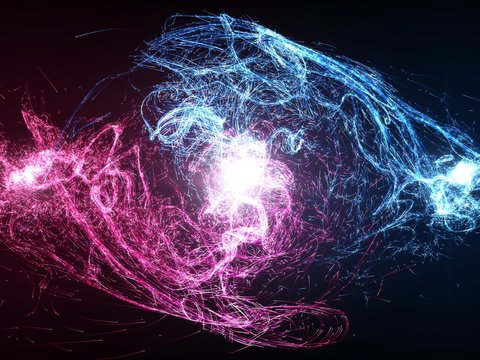
At its core, fusion is the process of forcing two atomic nuclei together to form a heavier nucleus, releasing enormous amounts of energy in the process.
Atoms normally repel each other because their nuclei carry positive electric charges. To fuse, nuclei must be brought so close together (within about 10⁻¹⁵ meters) that the strong nuclear force overwhelms that repulsion. Nuclei can get this close under conditions of extreme temperature and pressure: hundreds of millions of degrees Celsius.
This is exactly what happens inside the core of the Sun. Gravity squeezes hydrogen plasma to such density and heat that protons fuse constantly, releasing the light and warmth that sustains all life on Earth. On Earth, we aim to replicate this process in a controlled environment, without the Sun’s crushing gravity, using magnetic fields, lasers, or electric fields to confine the hot plasma.
Replicating the Sun’s energy in such a process on Earth would generate energy using resources that are more sustainable than fossil fuels and without generating carbon emissions. A successful commercial fusion reactor would be transformative for civilization.
Proton–Boron-11 Fusion
The fuels selected for generating fusion energy on Earth are primarily hydrogen isotopes. Among all these fusion reactions, proton–boron-11 (p-¹¹B) stands apart. The D-T reaction produces more energy than other reactions under the same conditions. The fuel, hydrogen-1 and boron-11, are naturally abundant and can produce fusion energy without the long-lived radioactive waste produced by many other fusion reactions. Fusion energy from the p-B reaction is ambitious and highly-debated, yet is potentially the most sustainable long-term solution.
Proton–boron fusion is nearly completely aneutronic: it produces no neutrons in its primary reaction, generating instead three helium-4 nuclei (alpha particles) in a large burst of energy. This fundamentally changes what a fusion reactor could look like, and what it could do.
The Reaction
When a proton (the nucleus of ordinary hydrogen, ¹H) collides with a boron-11 nucleus (¹¹B) at sufficient energy, they briefly form an excited carbon-12 nucleus, which immediately breaks apart into three alpha particles:
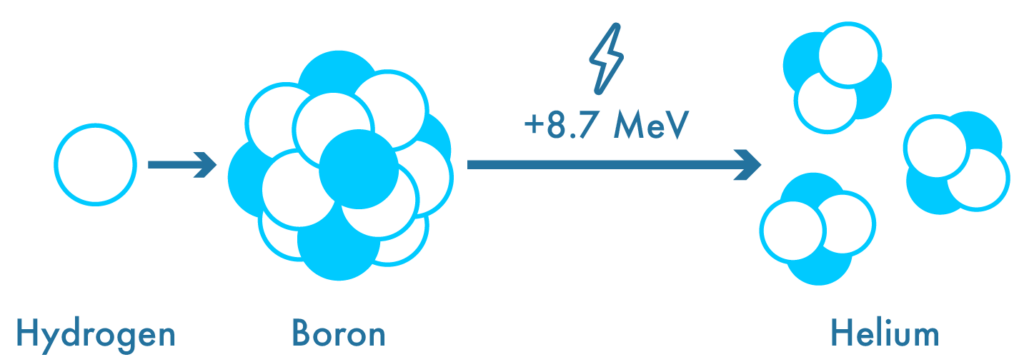
p (hydrogen-1) + ¹¹B (boron-11) → 3 × ⁴He (alpha particles) + 8.7 MeV
Each reaction releases approximately 8.7 million electron volts of kinetic energy, carried entirely by charged particles, not neutrons.
Boron-11 makes up about 80% of naturally occurring boron. It is stable, non-radioactive, and abundant in borate mineral deposits worldwide. Hydrogen (protons) is, of course, the most common element in the universe. The fuels are cheap, widely available, and non-toxic.
The Aneutronic Advantage
This is the defining feature of p-¹¹B fusion. In D-T reactions, roughly 80% of the fusion energy is carried by a high-energy neutron that slams into the reactor wall, causing atomic displacement damage and making materials radioactive over time. Managing neutrons is one of the great engineering challenges of conventional fusion.
In proton–boron fusion, the primary products are three charged alpha particles, helium nuclei moving at high speed. No neutrons means no wall activation, no radiation shielding for the plasma chamber, longer-lived structural components, and a dramatically simpler waste picture. After a reactor’s lifetime, materials would become only mildly activated from trace secondary reactions, reaching safe levels in decades rather than centuries.
There is a secondary side reaction, a small fraction of boron-11 captures a proton and undergoes a different pathway, producing carbon-12 and a gamma ray, but this branch is minor and manageable. Overall neutron production from p-¹¹B is several orders of magnitude lower than D-T fusion.
Direct Energy Conversion
Because the fusion products are charged particles, p-¹¹B opens the door to direct energy conversion — a method that could theoretically convert up to 70% or more of the reaction energy directly into electricity, bypassing the inefficient turbine-and-heat-exchanger cycle that conventional power plants use. In a direct conversion scheme, the alpha particles’ kinetic energy decelerates against an electrostatic field, generating voltage directly. This could make a p-¹¹B reactor far more electrically efficient than any steam-cycle plant.
Who is Working on It?
A number of companies and research groups are pursuing p-¹¹B fusion specifically, or are developing technologies applicable to it. TAE Technologies (formerly Tri Alpha Energy) in California has built a series of plasma devices using a field-reversed configuration and has explicitly targeted hydrogen–boron as its end goal. HB11 Energy in Australia is pursuing a laser-driven approach, using high-powered lasers to ignite boron-rich targets; they reported experimental evidence in 2021 of alpha particle generation from laser-driven p-¹¹B reactions at levels higher than classical theory predicted, sparking significant scientific interest. Focused Energy and others are developing related inertial confinement techniques.
Progress is real but the distance to a net-energy-gain device remains large. The consensus among mainstream plasma physicists is that p-¹¹B is decades behind D-T in development timeline, though the prize, a clean, aneutronic, essentially unlimited power source justifies continued serious investment.
Other Approaches to Fusion
Not all fusion reactions are equal. Physicists have studied several candidate reactions, each with different fuel requirements, ignition temperatures, and by-products.
Deuterium–Tritium (D-T)
The most studied and currently most advanced fusion reaction. Deuterium (hydrogen-2) and tritium (hydrogen-3) fuse to produce helium-4 and a high-energy neutron. The ignition temperature is relatively “low” at around 100 million °C, making it the easiest reaction to achieve. ITER, the massive international fusion experiment under construction in France, uses this approach. The downsides are that tritium is rare and must be bred from lithium, and the energetic neutrons cause significant activation of reactor materials over time.
Deuterium–Deuterium (D-D)
Uses only deuterium, which is extracted from ordinary seawater and is practically inexhaustible. However, D-D reactions require higher temperatures than D-T and have a lower energy yield. Over time the D-D reaction produces four products in about equal counts. The three charged products: proton, triton, and deuteron would have a similar potential advantage of direct-conversion as p-11B if a high enough reaction rate could be reached, but it also produces neutrons, though significantly less than D-T. This complexity of products, however, make D-D an excellent choice for fusion education and research.
Deuterium–Helium-3 (D-³He)
An attractive reaction because it produces very few neutrons nearly “aneutronic” reducing material damage and radioactive activation. It also allows for the possibility of directly converting the charged particle output into electricity. The catch: helium-3 is extraordinarily rare on Earth, though it exists in larger quantities on the Moon’s surface, making it a long-term but logistically challenging fuel.