Peer-reviewed study shares calibrated measurements from a proton–LaB₆ glow-discharge system and invites independent verification
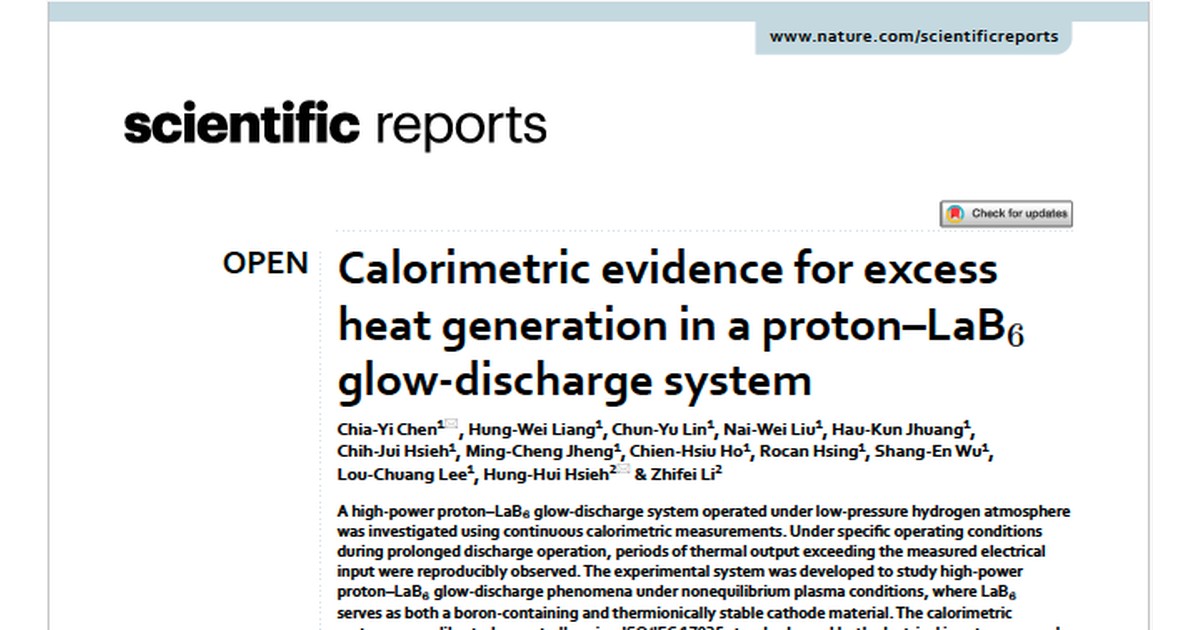
TAIPEI, Taiwan & MONTEREY, Calif. — July 18, 2026— Research from Alpha Ring International (聚界潔能) has been published in Nature Portfolio. The peer-reviewed study, titled “Calorimetric evidence for excess heat generation in a proton–LaB₆ glow-discharge system,” appeared on July 17, 2026, in Scientific Reports, the open-access, multidisciplinary journal in the Nature Portfolio family.
Publication in a Nature Portfolio journal means the work passed independent peer review and is now openly available for scientists worldwide to read, evaluate and build on.
The paper describes the team’s experiments with a high-power glow-discharge system operated in a low-pressure hydrogen atmosphere. The system uses a lanthanum hexaboride (LaB₆) cathode, a boron-containing material that remains stable at high temperatures.
What the Study Found
- Calibrated measurements: Input-power instruments were calibrated by the Taiwan Testing and Certification Center (TTCC) under ISO/IEC 17025, and electrical input and water-cooling thermal output were monitored continuously throughout each run.
- Thermal output above electrical input: Under specific higher-power conditions, integrated thermal output exceeded electrical input. In the highest-gain interval, output was about 10% higher than input for roughly 300 seconds, a deviation larger than the estimated 3σ measurement uncertainty of 4.2–5.8%.
- Material-specific behavior: Control experiments with tungsten cathodes under comparable conditions showed no significant excess (gain of 1.009 ± 0.019).
- Chemical sources considered: Surface analysis showed oxidation, erosion and redeposition on used LaB₆ cathodes, but the maximum chemical energy estimated from cathode mass loss accounts for only about 3% of the observed excess.
An Open Scientific Question
The authors state clearly that the physical origin of the observed excess energy remains unresolved. The effect did not appear in every operating regime and occurred more often near conditions where plasma instability was also more pronounced. The paper is presented as a carefully calibrated experimental report. Future work will focus on direct detection of possible charged-particle signatures, and the team welcomes further study and independent verification.
Research Team
The paper was authored by Alpha Ring researchers in Taipei and Monterey, California: Chia-Yi Chen, Hung-Wei Liang, Chun-Yu Lin, Nai-Wei Liu, Hau-Kun Jhuang, Chih-Jui Hsieh, Ming-Cheng Jheng, Chien-Hsiu Ho, Rocan Hsing, Shang-En Wu, Lou-Chuang Lee, Hung-Hui Hsieh and Zhifei Li.
Read the Full Paper
Scientific Reports (2026), DOI: 10.1038/s41598-026-60798-y — https://doi.org/10.1038/s41598-026-60798-y